
HISTORICAL INFORMATION
TOURIST ROUTE
TOURIST ROUTE
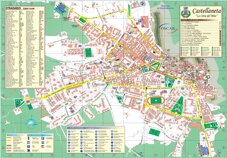
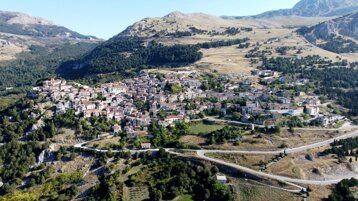
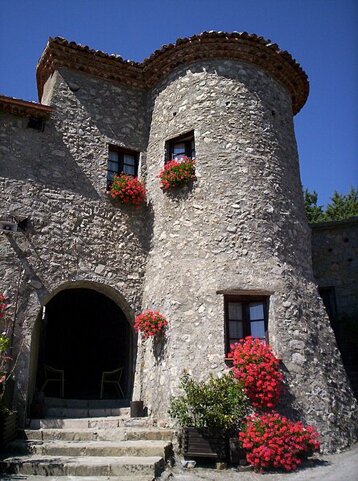
Marsicovetere has maintained the appearance of a medieval village, with stone streets, narrow alleys, precious arches (which served as buttresses for the houses) and historic portals. Perched on a rocky ridge, with its 1037 meters of altitude, it dominates the beautiful Agri Valley. The village has very ancient origins, confirmed by still visible remains of the civilization that populated this area for the first time. Following the destruction of Grumentum (878 AD) by the Saracens, the inhabitants of the area took refuge on the rocky spur, giving rise to the current town. The name derives from the Marsi, an ethnic group that settled in the territory from Marsica, in Abruzzo. According to Racioppi, it could also derive from Marsicus, an adjective used in the late ages to define a marshy place (because such was the valley below), with the addition of Vetus to distinguish it from Marsicus Novus, today's Marsico Nuovo, founded later. In 1118, the presence of the castle with the surrounding village is attested, whose owner was a certain Bartolomeo. In the deed of donation we read "Bartolomeus de castello Marsici Veteri inclitus dominus". It can therefore be said that, in the 11th century, the settlement already bore this name. Over time, Marsicovetere was a fiefdom of various families belonging to the Caracciolo family who, after a brief parenthesis of the De Palma family, governed it until 1777, ensuring the town significant development. A particularly devastating historical event for Marsicovetere was the earthquake of 1857, which marked the beginning of the crisis that lasted until the 1950s. The village began to rise again with the development of the hamlet of Pedali (at the foot of the mountain). The latter changed its name to Villa d'Agri with municipal resolution no. 4 of 18/01/1955 and subsequent DECREE of the President of the Republic of 13/01/1957. From that date, Villa d'Agri has undergone profound changes, from an economic point of view, compared to the center on which it depends. The passage of the valley floor meant that it became the seat of the major district services and commercial driving force. The local civil hospital, the ASP headquarters, the fire brigade, etc. were added to the Land Reclamation Consortium, established around the 1950s. There are few monumental beauties to mention: the 20th century Church of S. Maria Addolorata, which is accessed via a large stone staircase, and the fortified Piccininni farmhouse (the farmer's seat), a massive construction with a small internal courtyard. On the right of one of the first bends of the road that connects Villa D'Agri to Marsicovetere, you can see the convent of S. Maria dell'Aspro. The convent was probably the home of Friar Angelo Clareno, a Franciscan heretic who arrived in Val d'Agri at the beginning of the 14th century. Here the friar earned his fame as a miracle worker, attracting crowds of believers from all over the region to the convent. The archaeological excavation campaign, carried out inside the convent, has brought to light numerous ancient finds, dating between the 14th-15th-16th centuries, evidence of the past and of the strong architectural signs that the Marsicovetere community has inherited from history. The convent, like that of Santa Maria di Costantinopoli, close to the historic center of the village, consists of a wing in which the monks' cells were located around a cloister and a sacred building, inside which there are traces of a few frescoes, depicting Franciscan friars. The Franciscan presence in this convent was more or less considerable until its complete suppression in 1792, by decree of Ferdinand of Bourbon, King of Naples. Following the earthquake of 1857, the convent suffered serious damage. A recovery intervention was carried out, financed by the VAL D'AGRI, MELANDRO, SAURO, CAMASTRA OPERATIONAL PROGRAM fund deriving from oil royalties. Worth noting in Villa d'Agri is "PALAZZO PICCININNI-D'OTTAVIO": the so-called "PALAZZO" was built by the Caracciolo family and then sold to the Piccininni family who currently share it with the D'Ottavio family. The property also includes the private Chapel of Sant'Antonio Abate which dates back, in its current form, to 1825 (as shown by the date carved on the window on the front) but already existed in 1736, as can be seen from an inventory of the assets of the PRINCE of Marsicovetere Domenico Caracciolo. Inside is kept the wooden statue of Sant'Antonio Abate, made in Naples in 1826, who is celebrated on the first Sunday in June. In the Pedali le Grotte area, ancient furnaces were found, which testify to the presence of a pre-Roman indigenous settlement. Worth mentioning is the historic "ZIPPARRI" bar, which in the past was the only point of reference in Pedali. Today it is still considered the hub of Villa D'Agri, where not only travellers from all over stop, but also locals for interpersonal exchanges and moments of relaxation and free time.
ROMAN VILLA OF THE BRUTTII PRAESENTES
It belonged to the BRUTTII PRAESENTES family, a Lucanian family that gave birth, among others, to the empress Bruttia Crispina, wife of Commodus in 178 AD. Discovered in 2006 during the work of positioning the pipes for the construction of the ENI oil pipeline. The villa is located at the foot of Mount Volturino and is bordered by the Molinara torrent in Barricelle. The building is a wonderful example of a rustic villa, both a residential and productive plant, which testifies to the notable economic development of the owners in the Val D'Agri. The Villa has been included in the program of the F.A.I. spring days.
RUINS OF THE CONVENT OF SANTA MARIA DI COSTANTINOPOLI
The ruins of the convent of Santa Maria di Costantinopoli are located at the foot of the historic center of the village. Commissioned in 1575 by Prince Ettore Caracciolo to the famous architect Pignoloso Cafaro, the building consists of a wing with a central cloister, around which the monks' cells stood on two floors, flanked by a sacred building with lateral niches, in which traces of frescoes depicting Saints and Christian symbols are visible. Outside the convent you can see a stone column, surmounted by a crucifix, also in stone. Held by the Capuchin monks, it suffered serious damage following the earthquake of 1857 and was never rebuilt.
L VASCH
From the Convent you can admire "L VASCH" in C.da San Leonardo in the private property of Giovanni Romagnano, unfortunately little known. During the Fascist period, the Apulian aqueduct built the pipes in these tanks. Two columns still visible today, testify to the work that was carried out in this place by the Fante company of Rome. The pipe, which went from Paterno to the tank (water jet) was made of cast iron, the one from the tank to Viggiano (channel) was made of concrete. The first pipe was water jet, the second channel. From Viggiano it continued to Puglia.
THE TOWER OF THE MEDIEVAL CASTLE
In the highest part of the historic center stands a majestic part of the ancient medieval castle (11th century) which, despite the adventurous past that has marked its history, has managed to preserve its treasures: the unique tower of the ancient manor (now owned by the Mazza family), a historic windmill and the two access gates to the fortress, on which three stone portals are visible. From one of these gates ("Porta Maggiore"), you can access via Castello and reach via Fossato. In fact, at the edge of the castle there was a moat, whose toponymy suggests the appearance that the structure must have had. Near the road, two water sources are visible on private property. Walking among the walls of the castle is like going back in time on a historical path, which reveals its secrets through internal staircases, tunnels and corridors. Thanks to its position, from the tower you can admire the entire surrounding valley and immerse yourself in a suggestive panorama. The image is that of an immense open-air stage and a true "living cultural landscape".
MADONNA DELLA NEVE CHAPEL
The chapel of the Madonna della Neve, belonging to the De Durante Marinelli family, dates back to 1830 and is visible along via Porta Maggiore, while its turret can be admired from Pianitello. On Palm Sunday it is open for the blessing of the palms.
MOTHER CHURCH OF THE HOLY APOSTLES PETER AND PAUL
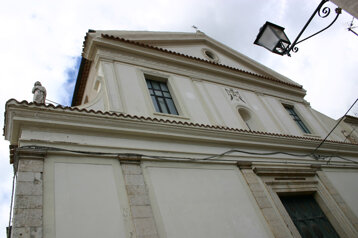
The church, built in the 14th century, was renovated in 1639 by the Caracciolo family, lords of Marsicovetere and renovated again in the 19th century in Neapolitan Baroque style. Restored twice more, due to the terrible earthquakes of 1857 and 1980, it features a pair of sculptures depicting Saints Peter and Paul.
Inside it houses a wooden sculpture from the 13th century, a work of the Angevin school, which in the past was placed on the facade of the building. It was then renamed "Madonna del Giubileo" in 2000. Also interesting inside are a 16th century baptismal font, a stone holy water stoup dating back to the 16th century and a wooden choir attributable to the 18th century. There are also 18th century paintings depicting works by followers of Caravaggio, including: "Saint John the Baptist", "Saint Bernardino" and "The Coronation of Mary". In a niche is kept the statue of the Madonna dell'Assunta (18th century), depicted on a cloud surrounded by cherub heads in an attitude of ecstasy, with her gaze turned towards the sky and her right arm raised. The simulacrum, according to local tradition, is carried in procession on the last Sunday of May and kept at the Sanctuary of Volturino until August 15, when it is brought back to the town. The mountain sanctuary, recently renovated (2008) in Gorgoglione stone, stands in the Piano dell'Imperatore area, a large plateau on the ridge of Mount Volturino, from which a path starts that can be used to reach the summit of the mountain. The bronze entrance door of the Mother Church was donated in 1893 by emigrants from Marsicovetere who moved to Philadelphia.
MONUMENTS TO THE FALLEN OF THE FIRST WORLD WAR
The monument, from a stylistic and iconographic analysis, seems to be ascribed to the knight Giuseppe Ciocchetti, active with his sculptures and commemorative plaques in numerous towns in Basilicata. It is a stone column sculpture, on top of which is a bronze statue, depicting an eagle with outstretched wings that overlooks a crown of oak and olive leaves. The column rests on a quadrangular base, bearing the commemorative inscriptions and the list of the fallen of the First World War. The monument was surrounded by a fence, removed in 2020 following a restoration of the monument, at the internal corners of which 4 unexploded war devices were placed. On the access gate there is a plaque, also in bronze, bearing the Victory Bulletin in relief.
GILIO FOUNTAIN
The fountain along Corso Vittorio Emanuele, was donated by Rocco Antonio Di Gilio, a chemist and pharmacist representing the Marsicoveterese colony of Chicago.
Under the Di Gilio fountain, we can admire an ancient washhouse, where the women of Marsicoveterese went to wash their clothes.
It was a meeting place, where people could tell stories and events that shook up life in the village. NOBLE PALACES ROSSI PALACE Palazzo Rossi is an ancient residence, built on three levels and surrounded by gardens, with a wide panoramic view of the entire valley. Today it is used as a holiday home, but it was built in the early 1800s as the home of the family of the same name. ZIELLA PALACE Palazzo Ziella dates back to the 17th century. Today inhabited, it preserves a beautiful stone painting inside. TRANCHITELLA PALACE Palazzo Tranchitella, located on Corso Garibaldi, dates back to the 18th century. It is embellished with a portal in local stone. Palazzo Pascale, located on Corso Roma, also has a stone portal. Inside the palace there is a cistern, which connects to the ancient moat. PICCININNI PALACE The palace dates back to the 17th-18th century. Located in the old part of the town, it has a stone portal with a coat of arms, round single-lancet windows, arches, a characteristic loggia and terraced gardens. Curiosity: many of the portals made with local stone are the work of the very skilled stonemasons of Marsicovetere, who once worked in the numerous workshops of the village. COATS OF ARMS AND PORTALS Even in our village, as in all the other villages, the existence of some noble families of the past is evidenced by the presence of coats of arms, placed on the portals of the houses, as a sign of recognition. In fact, each important family corresponded to this sort of distinctive sign, and reporting it on goods and properties was useful to indicate ownership. THE ARCHES Among the many characteristics of the village, it is important to mention the many arches, built to act as buttresses for the houses. Walking through the village, and passing through its tunnels and arches, is an adventure to try: the tourist is immersed in a journey into the past that arouses emotions and stimulates curiosity...
EVENTS AND FLAVOURS
THE MUSEUMS
EXCURSIONS
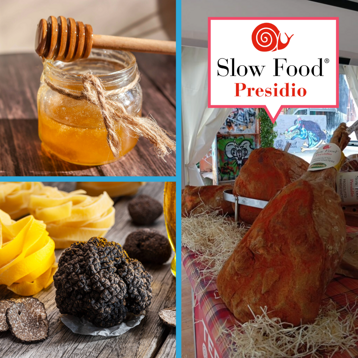
The “Rassegna Enogastronomica dei Vini e del Tartufo Lucano” is the main event of the summer and is held on August 14 in the splendid setting of the historic center. Local restaurants prepare tasty recipes with truffles, accompanied by excellent organic wine produced by local companies. The food and wine route winds through the most suggestive and characteristic corners of the town, in the stands you can find local handicrafts and you can taste the famous “Prosciutto Marsicoveterese – Presidio Slow Food”. The raw ham is obtained from the meat of large white, duroc and cross-breed or nero lucano pigs raised in a semi-wild state and aged in historic rooms for maturing in the municipality of Marsicovetere at over 1000 meters above sea level, where the cool mountain winds meet the warm sea winds. After a period of rest in salt, which lasts from 25 to 40 days, it is pressed. The legs are then covered with a mixture of lard, pepper and sweet pepper powder and left to dry in rooms with a wood fire. The maturing period ranges from 12 to 22 months and more. Another excellent local product is certainly honey. With a crystalline color, sometimes darker and a delicate or more bitter flavor, it is often associated with cheeses produced according to the Lucanian tradition. Processed according to the most traditional procedures, honey is the undisputed protagonist in ancient and modern recipes. On August 15, raw ham returns to be the protagonist of the festival. The event is an opportunity to spend a pleasant vacation in the mountains. The faithful bring the statue of the Madonna dell'Assunta back to the church of Marsicovetere, after a stay in the Sanctuary of Volturino. On May 20, the celebrations in honor of San Bernardino da Siena, patron saint of the Municipality of Marsicovetere, take place. On the first Sunday in June, Sant'Antonio Abate is celebrated in Villa d'Agri and on the third Sunday in September the Madonna Addolorata. In the hamlet of Barricelle, on May 1st, San Giuseppe Lavoratore is celebrated. Also very evocative are the eve of San Giuseppe, on March 18th, characterized by large bonfires lit in the streets of the town and the figurative Via Crucis on Good Friday.
MUSEUM OF RURAL CIVILIZATION - "THE HOUSE OF DORINA"
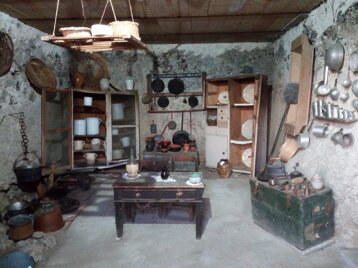
The museum is a house, transformed into a hub by Prof. Briglia Isabella, containing relics and ancient work tools that enclose the experience of an existence made of work and sacrifices. Located in via Castello, it has a garden that guarantees a breathtaking view of the Agri Valley and from which, among other things, you can admire the Tuppo di San Nicola, on which you can see the signs of the ancient Civitas, while on the right you can glimpse the Copone spring and the peak of Mount Volturino.
HOUSE MUSEUM DE DURANTE - MARINELLI
The house museum, located in the historic center, was created with the intent of enhancing the Medieval Lucanian villages and their customs. It is organized on two levels: on the first is placed a private collection of nativity scenes by Dr. Rosapina Marinelli, with sets created specifically to reproduce the Marsicovetere and Lucanian tradition; on the second you can admire an authentic noble residence from the early 1900s.
MUSEO ARCHEO-S
The museum, located in the historic center of Marsicovetere in C/so Vittorio Emanuele, is an Experimental Archaeology project, educational and informative, aimed at everyone. Inside there is a collection of objects, reconstructed after a careful study of the historical and archaeological sources, ranging from Prehistory to the Roman era, a rich sample of tools linked to the daily life of our ancestors.
VILLA MARCONI
Important for the historic center is VILLA MARCONI, a meeting place for
young and old on warm summer evenings, where you can enjoy the healthy air. Called "U CHIANUTIEDD", it is characterized by the presence of games for children.
COPONE THERMAL SPRING
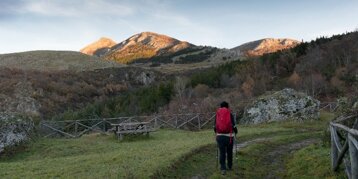
The thermal spring, about 1 km from the historic center, is famous for its very pure water, with oligo-mineral properties and proven effectiveness for kidney stones. The surrounding area is equipped for picnics. In the past, the women of the historic center went to this place to wash their clothes (washtub), which they then left to dry by hanging them directly on the hedges that surrounded it. From the spring it is possible to cross various paths, including the "twenty-year path". The excursion starts from the Capone spring and continues towards "Tuppo delle seti", from which you enter the beech forest, which leads to the "piano Imperatore", where you can admire the Sanctuary of the Madonna dell'Assunta. From the mountain church you reach the highest peak of the Volturino at 1836 m. a.s.l.
L' GRUTT
In the 1940s, when the Americans invaded the plain and went to bomb the
airfield that the Germans had built above Tramutala, the Marsicoveteresi abandoned their homes and took refuge in these caves. Only a few remained at home, fearing that they would be robbed during the night. When the Germans abandoned the landing field above Tramutala and headed towards Cassino, the refugees in the caves returned to the historic center. From a well-founded testimony (Dionisio Curcio), it is clear that the Americans who remained in the plain raided the grapes that had ripened in the vineyards of the Marsicoveteresi, who that year did not produce wine. CURIOSITY: the enormous boulders visible today under the caves, detached from the mountain during the terrible earthquake of 1857 and rolled down, where today they constitute a splendid scenery.
CLIMBING
There are various boulders, in the municipality of Marsicovetere, on which it is possible to go climbing: Masso dei Gallesi - Riserva Indiana -Pietra del Gufo Brigante al Sole - Brigante alla Luna.
PRO LOCO
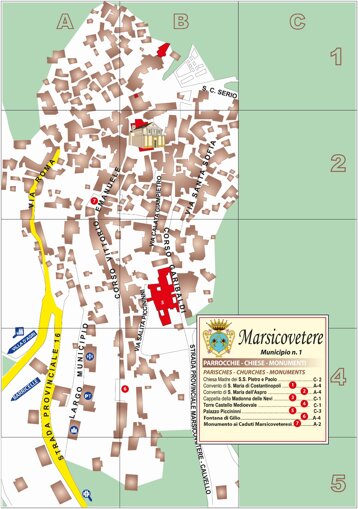
MARSICOVETERE
CLICK ON THE PHOTO TO ENLARGE
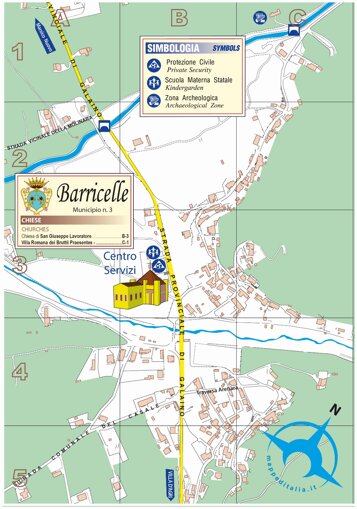
BARRICELLE
CLICK ON THE PHOTO TO ENLARGE
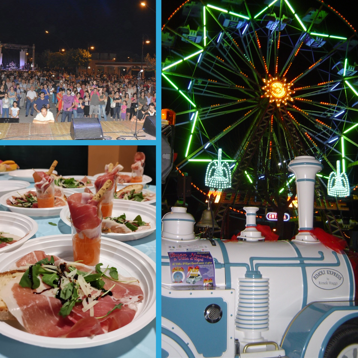
The Pro-Loco of Villa d’Agri President Luigi Laddaga, is a non-profit association, which works hard to organize cultural events, shows and various entertainment, with the aim of making the territory known and promoting tourism in Val d’Agri. Some events have been included in the program capable of rediscovering and promoting the social, cultural, artistic and sports aggregation of our territory. The association focuses its activities within two macro events, called "MERRY CHRISTMAS IN VILLA D'AGRI" and "VILLAESTETEVI". With MERRY CHRISTMAS IN VILLA D'AGRI, during the entire holiday period, Christmas videos and musical concerts are shown and Santa Claus distributes gifts to the little ones. In past years the event has been very successful, due to some of the new features introduced, such as the itinerant train, the dancing fountains, the Ferris wheel and much more. The events have attracted numerous tourists from neighboring regions, many young people and families from the valley who have made Villa d'Agri and its territory the center of many entertainment and social gathering activities. The Association, starting from December 8, in addition to the installation of the now traditional nativity scene created by volunteers, will liven up the square with Christmas shows aimed especially at the little ones. VILLAESTATEVI is an artistic and cultural event that takes place between the end of July and the first weeks of August. In past years the event has been very successful for some innovations introduced with the performance of over 150 Lucanian artists in the splendid setting of the Piazza. The main event is undoubtedly the tasting of Marsicovetere ham - Sagra del Prosciutto, an event that has now been going on for over 50 years. In the central Piazza Zecchettin in Villa d’Agri, during the last weekend of July, you can savour the unique and irresistible taste of ham, a key ingredient in classic recipes, but especially in the “gourmet” trend.
MAPPEDITALIA SOCIAL
Mappeditalia.it © Tutti i diritti riservati