
HISTORICAL INFORMATION
PARETE PINTO
STORNARA NATURE RESERVE
Tito Livio in una delle sue opera storiche narrates that on a morning in the spring of 210 BC. some shepherds who lead the greggi to the pascolo, press the locality called “palude fetida”, assistettero allo scontro their due naval formations, a tarantine and the other Roman. The combat ended with the fire and the loss of much of the equipment. The episode begins on the course of the First Punic War in the locality “Sapriportem”. The site indicates rich in the territory of Palagiano. Inoltre, we saw a geographical map of the ancient territory of "Magna Grecia", we could easily see that the Palagiano farm was found in the heart of a territory that was interesting, without the dawn of the VIII century BC, of the colonization of Greece (Dori). This toponym derives from the Greek "Palaios-Schenè" and also "Antico Accampamento" which in the local language is pronounced: "Palascene". I did find it easy to apply in the coastal zone and, attratti dalla fertilità dell'entroterra, cominciarono to cultivate the olive tree and to sviluppare and improve the technique for the allevamento. I was first born in the next few years in localities: Chiatona, Calzo, Lenne, Trovara and Fontana del Fico. In these places, archaeological research has been carried out there and there are numerous tombs from the IV and III centuries B.C. In the second goal of the XI sec. The territory of Palagiano is a pole of rock formations in the western part of Tarantino with the site of Santa Maria di Lenne. The city did find, because the arrogance of Murcaldo, fiduciary of the Tarantino prince Boemondo, who left for the crociate, lasciò il feudo in his mani, will rise. Dopo l'infeudamento normanno e il possedimento angioino, le terre palagianesi passedarono a molti altri feudatari fine alla family Caracciolo che restò fine ai primi anni dell'800. The palagianese community has always seen every moment of the political and social history with its aneliti, the longing and hope of voler affermare and proper civil values. Enough to remember and contribute locally for the participation of the people of the Unit of Italy. Non varie dimenticate the various political activity and the rivendicazioni contadine ed operaie delle leghe del primo novecento, fine ad arrivare alla tribolata fascist experience and all'impegno per la ricostruzione democratica del secondo dopoguerra, in relation especially alla Riforma Fondiaria, che proprio a Palagiano foresees the localization of one of the poli di coordination.
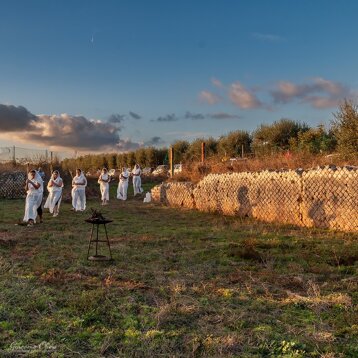
The old communal road through Palagianello in the locality of Parete Pinto, 1 km from Via Appia and around Palagiano, is located in an agricultural field with a Roman structure that is almost Augustan (after the 1st century B.C. and the 1st century AD). Such a structure, which covers an area of 2,834 mq, preserves and remains of a 1.50 m high enclosure, thick 60 cm in opus reticolatum, technique carried out with the use of diamond stone blocks, regolari di 10 cm fixed with a ghiaia impasto and lava fredda del Vesuvio. The poggia wall has a foundation with rows of irregular calcareous stones 40-50 cm and length 70-85 cm. The trapezoidal-shaped wall perimeter presents three entrances, due to the vertici of the northern side and one step closer to the center of the southern side. What we dobbiamo see in what resti? Ancora oggi sono en piedi due ipotesi, enclosure per animali annexe ad una Roman villa, statio ad canals, (luogo di sosta) per cui non abbiamo a precise identification of this posto. I do not necessarily have written documentation to support either one or another of these, if we must proceed per ipotesi based on what we see not only in the luogo di cui stiamo parlando ma also in posti vicini. And since on the basis of this premessa the interpretative thesis of the statio ad canals comes suffragata da un paio di elementsi. When after 50 and 60 years were condotti and first rilievi, the honorarium of the era, Vincenzo Cetera pointed out that the original struttura dovesse essere costituita da una zonae centrale adibita ad abitazione ed ufficio del commandante del presidio (pretorium), da altre due destinante al ricovero dei militia (excubiae) and other anchors used as stalls and services (stabulum). The stazio quindi, a kilometer from the Regina Viarum, the Via Appia, was a luogo di ristoro dei soldati in viaggio anche perché aveva modo di approvvigionarsi di aqua sfruttando la sorgente della fontana di Fico, nei cui pressi c’era also a cisterna de raccolta e deposito ricoperta di malta idraulica. Peraltro, the presence of a collateral structure alla statio, cioè of a mansion with more or less these functions (sosta e Cambio de cavalli e ristoro dei viandanti) individuata nel palagianese territory and coincident with that which popularly ancora oggi comes chiamata Taverna (active come tale fine in 1938), darebbe senso all'ipotesi della statio appunto, insieme al rinvenimento de un another impianto simile delle vicinanze, ossia di un’altra statio, a Montecamplo nei pressi di Castellaneta. In the first place, if the source of the “Fontana del Fico” is opened, in a crossroads of the Via Appia, which without dubbio will be opened for various dryers of the occupants of the station, an corked fornitary for the water can be drained into a cistern, rinvenuta about thirty meters away from the stessa. This cistern was filled around 1960, during the work of removing the land to clean the vines. Interessante però è also la relation svolta dal sovrintendente archeologico De Jiulis in un convegno tenutosi negli anni Ottanta in seguito ad altri scavi che furono effettuati. Secondly, the studies on the invention of numerous fragments of tegole, the walls of large vessels and the rest of the animals' bones, ensure that the structure serves the enclosure for animals and that faces part of a large Roman villa with a rustic annex. On the other hand, the entrance from the southern side, presents a narrow structure in the central part with a limestone mass, height 80 cm and length 40 cm. Trattasi probabilmente di un passaggio delimitato per la conta, la tosatura e la mungitura degli animali, e per il passaggio dei custodi. Vero è che non sappiamo se De Jiulis abbia fatto esaminare and reperti ossei o effectuato altre ricerche specifiche per stabilirne l'età e magari collegare la loro presenza all'attività organized, in tempi più recenti, di qualche impianto già existente adattato diversemente rispetto all'uso del system stradale della via Appia. And it is possible to render the possibility of entering the data of the statio ad canals first and that of the enclosure of a dopo Roman villa. Strutture diverse che si sono succedute nel tempo.
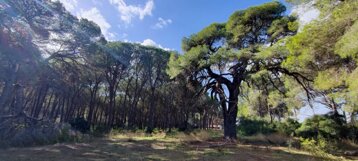
In the heart of the Stornara Nature Reserve, in the territory of Palagiano, there is the area known as Pino di Lenne, which takes its name from the presence of extensive Aleppo pine forests and the proximity of the Lenne River, a waterway that crosses the territory for about 24 km before flowing into the Ionian Sea. Inside this area, immersed in the vegetation of the reserve, stands a monumental example of Aleppo pine, recognized as one of the oldest in Europe. With an estimated age of over 300 years, this tree represents an important botanical heritage, a symbol of resilience and an integral part of the cultural identity of the local community. Its grandeur is evident from its height of about 20 meters and the circumference of the trunk that reaches 4 meters, while the large and majestic crown offers extensive and welcoming shade, testifying to its ability to resist centuries of climate and environmental changes. The Stornara Nature Reserve, which extends for about 7 km along the Ionian coastal strip, is characterized by an ecosystem rich in biodiversity typical of the Mediterranean scrub. Around the monumental specimen of Aleppo pine, it is possible to observe plant species such as phillyrea, strawberry tree, red juniper, mastic, broom, cistus, rosemary and prickly asparagus. This floral variety contributes to the stability of the dune ecosystem, offering refuge and nourishment to numerous animal species and promoting the conservation of the environmental balance. The presence of this very varied habitat not only enriches the natural landscape, but also represents a precious resource for botanical, faunal and environmental studies. Aware of the value of this natural heritage, the community of Palagiano, in collaboration with the Pro Loco and other institutions, is actively involved in the protection and enhancement of the area of the Lenne Pine. Botanical trails have been created to guide visitors to discover the main Mediterranean essences, observation points to admire the local fauna and areas equipped for picnics that allow you to experience moments of relaxation immersed in nature. The trails are enriched by information signs that show images and descriptions of the plant and animal species present in the forest. It is possible to learn curiosities about the main aromatic plants, the typical shrubs of the Mediterranean scrub and the different fauna species that populate the area, including migratory birds, small mammals and reptiles. In addition to the information trails, spaces have been set up for observing the fauna and areas dedicated to outdoor workshops, aimed in particular at schools and families. During guided tours, experts illustrate the ecosystem of the reserve and the importance of environmental conservation, raising awareness among participants of the fundamental role that everyone can play in protecting the natural heritage. These initiatives aim to promote sustainable and conscious tourism capable of enhancing the beauty of the territory.
FEAST OF THE MADONNA DELLA STELLA
THE SEMIPOGEE FRANTOIO
THE CLEMENTINES
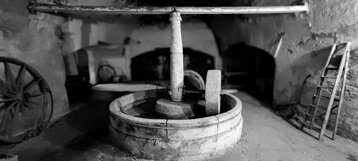
Precious and silent testimony of the past, the semi-pogee frantoio sito in Corso Lenne a Palagiano, laughing at the end of the 18th century. Note all the Sovrintendenza, dal 2006 il frantoio è sottoposto a vincolo architettonico. I frantoi, chiamati anche trappeti, sono i simboli della civiltà contadina, in particular legati alla coltivazione degli ulivi che, sin dall’antichità, hanno rappresentato per il nosstro territorio un important fattore di crescita e di sviluppo. Quelli ipogei, very diffusi fine alla fine del 700, sono i più ancient. This was considered unhealthy in 1800, with the affermarsi of the industrial età, cominciarono ad essere sostituiti da altri trappeti costruiti on surface. E diversi furono i frantoi (di cui si ha memoria e di cui sono rimaste piccole tracce) realized a Palagiano in diverse points of the country, expressions of an agricultural community strongly bequeathed to the culture of the ulivo. The main space with an open room covers a surface area of 392 mq. It presents a flooring in listelli di pietra, pareti innacate a calce, voltato a botte. Collocata ad est della grande sala, la macina circolare in pietra conserves ancora gli ingranaggi in legno e le pale en metallo all’interno della vasca sottostante, che servivano a raccogliere e posizionare l’impasto delle olive schiacciate sotto la mola. Ad azionare questo ingranaggio, con l’ausilio di un rudder, era un asinello e/o un mulo, animali che condividevano questo spazio terraneo con gli uomini. Infatti, long la parete a destra dell'entrata si apre un atro che serviva da stalla e mangiatoia. In the semi-darkness of that space a Scandinavian campanello and passedi dell'animal che, blessed, turned intorno alla vasca. At the end of the cycle of six months of work, in the largest part of the almost, the poor beast ormai stremata, may serve only eat macello meat. Quello del “trappitaro” was not a labor per tutti. Gli operai were only uomini, unti, nerboruti, tenacissimi nella resistance, che vivavano in questo luogo chiuso per month, autunno and winter, novembre ad aprile, senza verdere la luz del sol. The work was in a continuous cycle, with shifts of riposo all'internal to the current ones. Ai trappitari was concesso ricongiungersi all the families only in the days of the Immacolata, of Natale and of Capodanno, when the megalithic machine began to turn. Near the manger, other related rooms with stone seats, once covered with straw, were used as spaces for rest. Instead, on the wall in front of the door, there is a recess with a large fireplace that served as a kitchen and as a source of heating. To the left of the fireplace room, on the same wall, there are two “Genoese” presses and a stone worktop called “mantra” with a back wall in enameled majolica, a touch of color in this dark and underground place. On the mantra, after the olives had been ground in the mill, the work of filling (with the oil paste obtained) and preparation of the fiscoli took place, which then passed to the pressing or pressing phase. The liquid obtained was conveyed into small wells below where it remained to decant until the moment of “cutting”, that is, the natural separation of the oil from the vegetation water, the “sintina” that remained on the bottom. The “Genoese” presses, easier to handle than the older ones, replaced the larger “Calabrian” ones, traces of which remain in the area in front of a large niche that opens into the western wall of the room. The latter were operated by a still visible gear called “ciuccia”. The olives were deposited in the room called “sciave” and lowered from the outside through openings connecting the road and the mill, called “chimini di discesa”. The olives thus piled up were subjected to a small natural heating process that favored their processing.
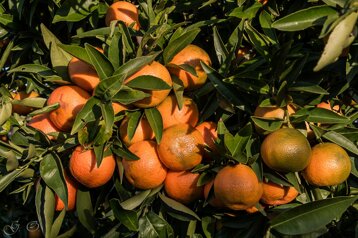
The Clementines of Palagiano, part of the Clementines of the Gulf of Taranto PGI, represent one of the citrus excellences of Puglia and Italy. Palagiano is known as the "Capital of Clementines" thanks to the quality of its production, the result of centuries-old agricultural traditions and ideal environmental conditions. This citrus fruit is the result of a cross between the bitter orange and the mandarin and has adapted perfectly to the territory, developing unique characteristics. The clementines of this area are characterized by their spheroidal shape slightly flattened at the poles, the thin and smooth peel with a bright orange color with possible green shades and a juicy, sweet and seedless pulp, a quality that makes them particularly appreciated for fresh consumption, but also for the production of juices, jams and typical local sweets. The balanced flavor between sweetness and acidity, combined with the intense and persistent aroma, makes the clementines of Palagiano a product of the highest quality, requested on national and international markets. The production area extends along the Ionian coast of Taranto and includes several municipalities including Palagiano, Massafra, Ginosa, Castellaneta, Palagianello, Taranto and Statte. This area enjoys a particular microclimate which, combined with the quality of the soil, guarantees optimal growth of the plants and the production of superior quality fruit. The cultivation of clementines follows traditional agricultural practices integrated with modern and sustainable techniques, annual pruning and manual harvesting, which allows the integrity of the fruit to be preserved and guarantees its freshness. Furthermore, the selection and packaging phase is carried out with great attention to maintaining high quality standards. The history of the cultivation of clementines in Palagiano dates back to the early decades of the twentieth century, when local farmers understood the potential of this fruit and began to dedicate large agricultural areas to its production. The growing success has led to the recognition of the Protected Geographical Indication (PGI) for the Clementines of the Gulf of Taranto, officially obtained on 22 September 2003 with EC Regulation no. 1665/2003, confirming the uniqueness and close connection between the product and its territory of origin. This recognition represented an important milestone for local producers and for the entire community, consolidating the position of Palagiano clementines on international markets and contributing significantly to the economy of the territory. Furthermore, on January 25, 2024, the Consortium for the Protection of IGP "Clementine del Golfo di Taranto" obtained official recognition through a Ministerial Decree, allowing the consortium to carry out activities of promotion, enhancement, surveillance and protection of the product. This important step has further strengthened the production chain, which involves hundreds of agricultural companies and cooperatives, offering numerous jobs and supporting the economic activities linked to the agri-food sector. In addition to their economic value, clementines are an integral part of the cultural identity of Palagiano and the surrounding municipalities. This bond is celebrated every year with the "Sagra del Mandarino", an event that attracts visitors from all over the region and represents an opportunity to promote not only the fruit, but also the local gastronomic and artisanal traditions. During the festival, the streets of the town come alive with tastings, shows, exhibitions and initiatives dedicated to the enhancement of the excellence of the area. Clementines are also protagonists in traditional cuisine, used to prepare desserts, liqueurs and typical dishes that enhance their aroma and sweetness. Environmental sustainability is a fundamental value for the producers of Palagiano, who adopt agricultural practices that respect the ecosystem and promote biodiversity within the citrus groves. The use of innovative techniques, such as monitoring parasites through natural methods and the controlled use of fertilizers, allows to reduce the environmental impact and guarantee healthy and quality production. The agricultural community is also committed to raising consumer awareness on the importance of choosing local and seasonal products, to the benefit of the environment and the local economy. The clementines of Palagiano, with their history, unparalleled quality and deep connection with tradition, represent a heritage that goes beyond commercial value. They are a symbol of a collective identity, of passion for the land and of agricultural knowledge that is handed down with pride. Their protection and promotion are essential to preserve the cultural and natural wealth of this corner of Puglia, offering future generations the opportunity to continue enjoying a fruit that is synonymous with excellence, tradition and sustainability.
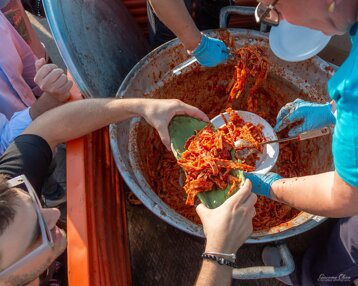
The second week of October in Palagiano, the feast of the Madonna della Stella is celebrated, to which the “tagghiarìn asccquànd” festival is traditionally linked. It is in fact a celebration that, although it has a religious devotional meaning for the Madonna, carries with it a strong folkloristic and picturesque charge that makes the celebration unique in our territory, and of great attraction for the neighboring communities. The heart of the celebrations is the sanctuary of the same name in the open countryside where popular legend sets an event that would justify the birth of this dish that has now become a symbol of Palagiano. Tagliatelle with hot chili pepper would have been prepared by a mysterious woman who in the mists of time welcomed fishermen who had escaped a shipwreck into her humble home; that very spicy meal would have warmed and comforted the men rescued. As a sign of gratitude and devotion, the sanctuary dedicated to the Morning Star was built in that place, the star that guided the sailors to land on the coast, the one that guided the farmers' work and to which they turned with prayers and songs to have good harvests. The first days of October begin, therefore, with the almost nocturnal call of the Fisckarùl (low music), the morning processions, the novena and the rosaries in honor of the Madonna. It is on Saturday afternoon that the most festive and characteristic moment takes place in front of the Marian sanctuary, bringing together hundreds and hundreds of devotees for the pasta ritual. The surrounding countryside is bathed in the intense scent of the spicy sauce that cooks in large pots and that will season kilos and kilos of fettuccine to be distributed to the population after the blessing. The carts that carry the cauldrons and that slowly move through the crowd are completely taken by storm. It is important for everyone to be able to get at least a taste of the “pasta della Madonna”, even if it means coming out completely covered in sauce. People use plastic dishes, but in ancient times they used prickly pear spatulas cleaned of thorns and a piece of cane as a fork. On Sunday morning, after the Eucharistic celebration, a heartfelt procession of the faithful, accompanied by musical bands, carries the Marian statue along the streets of the town, as it passes, showers of rose petals fall from the balconies dressed in elegant fabrics to greet and adore the Madonna della Stella. In a square full of lights and stalls, the solemnity ends in the evening, but not before with the traditional fireworks display.
S. ROCCO
S. NICOLA: THE CARAVEL
CHIATONA LOCATION
CLICK ON THE PHOTO TO ENLARGE
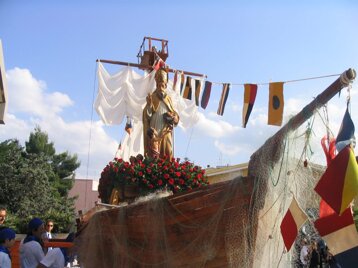
On April 4, 1971, with the opening of the current church of San Nicola to worship, the feast of the bishop of Mitra was established on the second Sunday of May, which has been enriched year after year with religious content, bringing awareness of the miracles performed by the Saint. The village festival was therefore born according to a fairly simple scheme of two days of illuminations, a Sunday procession and a final fireworks display. In 2000, on the occasion of the Jubilee, a tradition began that today represents an important characteristic of the feast of San Nicola in our country: the Historical Procession of the “CARAVELLA”. The project, desired and created by the parish priest Don Giuseppe Maraglino and the San Nicola Committee, was coordinated by the then president Cosimo Alemanno who, with his mastery as a carpenter, and with the help of Gerardo Tautonico, planed, shaped, glued and painted the material recovered by the boys of the parish and brought to the laboratory. From the great teamwork that involved all the parishioners, not only the Caravel was created, but other accessories complementary to the scenography that characterize the procession including the spectacular historical costumes that over two hundred participants wear, immersing those who witness their passage in an atmosphere of other times that excites and brings to life the story of the translation of the bones of the Saint from Mira to Bari. From that moment on, on Saturday afternoon, the effigy of the Saint, represented by a painting, goes around the streets of the town on the Caravel pulled by young men dressed as sailors and preceded by the historical procession in which the most famous miracles of the Saint are represented, that of the Virgins, that of the three resurrected children and that of the young Adeodato. The procession ends in the church square with the distribution of blessed sandwiches. Sunday evening, as usual, is reserved for the solemn mass followed by the gala procession that accompanies the statue of San Nicola to the sound of prayers, hymns and musical marches.
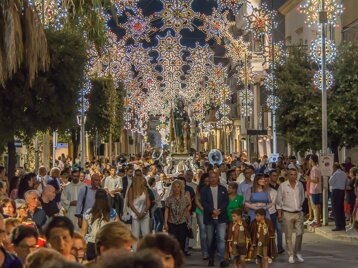
San Rocco is highly venerated by the people of Puglia and there are numerous celebrations in his honor from 16 to 19 August. He is usually depicted as a young pilgrim pointing to a bare and wounded leg; next to him stands the dog of Gottardo with a loaf of bread in his mouth. We know of the charitable events linked to the life of the saint who, by stripping himself of all his riches and giving them to the poor and needy, and putting his life at the service of the sick and the destitute, followed the example of Saint Francis in a period in which, we are at the beginning of 1300, our land where he was a pilgrim was struck by the scourge of the plague. His lifestyle and the sudden healings he performed earned him recognition of his sanctity. Invoked with Saint Sebastian as a protector against the plague since the early fifteenth century, his cult acquired extraordinary popularity in Italy in the second half of the century, as attested by the very rich iconographic material concerning him. And it was the Franciscan monks who spread the cult of San Rocco, Saint of charity and love for others in the South and, in particular, with regard to the territory of our diocese. The ecclesiastical decree that sanctioned the official nomination of Rocco as patron saint of Palagiano dates back to December 15, 1853. In a town where the presence of the Lenne river created the conditions for a climate particularly predisposed to the spread of malaria, the Holy healer became among the most invoked. And it is interesting to know that in ancient times the inhabitants of Palagiano performed the penitential rite of the session on the occasion of the feast: on August 16, those who had obtained a grace stopped in the church in front of the statue of the Saint, fasting for the entire day, and the children who had been miraculously healed were made to wear the Saint's uniform, the barefoot mothers carried candles in procession, and vases of flowers and basil were placed on the balconies. This anniversary has been celebrated in Palagiano for more than a century and a half, renewing and strengthening devotion to the Saint year after year. In particular, from 7 to 15 August, the novena takes place in preparation for the liturgical solemnity of the 16th when, in the mother church of the Annunziata, in the presence of the bishop and the city authorities, the rite of the delivery of the community's entrustment to San Rocco is celebrated with the symbolic delivery of the keys to the town, while the celebrations, according to ancient tradition, take place on the following Saturday, Sunday and Monday.
MAPPEDITALIA SOCIAL
Mappeditalia.it © Tutti i diritti riservati