

HISTORICAL INFORMATION
HISTORICAL INFORMATION
ARCHEOLOGY
Second Part
First Part
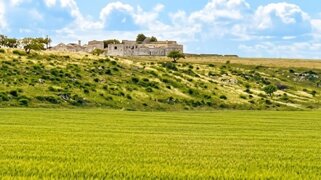
Monteiasi is a lively town situated in a fertile basin in the hinterland of Taranto, offering a panoramic view of the Mar Piccolo. Along with other neighboring municipalities (San Giorgio Jonico, San Marzano di San Giuseppe, Carosino, Faggiano, and Monteparano), it is part of the area known as "Albania Tarantina." After suffering for a long time from unemployment and rural depopulation between the 19th century and the first half of the 20th century, the town experienced an employment recovery in the late 1950s thanks to the Taranto steelworks complex. Subsequently, the crisis affecting major industry in the late 1980s drove a revitalization of the artisan and agri-food sectors. The origins of Monteiasi are the subject of various hypotheses, none of which are supported by definitive documentary evidence. According to some interpretations, the place name derives from the Greek *Monos Tiasos* ("sacred zone"), a reference to the numerous votive artifacts linked to the cult of Dionysus found in the area. Other theories link the name to the mythological figure of Jason, who is said to have founded the town during the voyage of the Argonauts, while the historian Arditi believes it derives from the town's geographical position, situated "between the hills" (*tra i monti*) of Montemesola, Monteprano, and Grottaglie. Archaeological evidence shows that the territory was inhabited as early as the Neolithic period, as attested by stone artifacts, settlement structures, and hearths discovered in the Palummara area. Later, the site saw the presence of Magna Graecia and Roman civilizations. During the Roman era, its proximity to the Appian Way fostered the creation of a stopping point for travelers and merchants—identified as *Parcus Taberna*, from which the current name "Barco della Taverna" derives—serving as a vital link between antiquity and the Middle Ages.
From the late 15th century onwards, the town's history becomes better documented. Its strategic location along major transport routes fostered the formation of the initial settlement, which grew around the *Masseria della Taverna* and the present-day *Palazzo Ducale*. In the 16th century, the farmhouse served as a station for the Sovereign Military Order of Saint John—later known as the Order of Malta. According to research by Giovanni Mattacchiera, the hamlet was founded at the behest of Geronima Delli Monti, the widow of Francesco Antonio Antoglietta; she obtained authorization to build the new settlement in 1513. The first inhabitants were farmers and artisans hailing primarily from Grottaglie. The Antoglietta family also encouraged the settlement of a community of Albanians who had arrived in Puglia between 1461 and 1470. This Albanian community contributed to the town's development and lived in harmony with the local population for a long time—until the end of the 16th century, when the transfer of the fiefdom to the ecclesiastical authorities of Taranto and the banning of the Greek rite triggered a new wave of migration and the subsequent depopulation of the area. Subsequently, Monteiasi was elevated to a barony and later a duchy, becoming part of the Ungaro family's estates. The family is linked to the legend of the miraculous healing of one of their sons before the relic of the *Santissimo Crocifisso* (Most Holy Crucifix); this event cemented the cult of the Crucifix, which was proclaimed the community's patron saint via a papal bull in 1682. In 1799, Monteiasi was also one of the starting points of the *Sanfedista* revolt against the Parthenopean Republic, playing a role in the restoration of the Bourbon monarchy. For a long period, the town remained a suburb of Grottaglie before establishing its own distinct historical and administrative identity.
The territory of Monteiasi—specifically the area at its northernmost edge, not far from the railway station and sloping down toward the Levrano d'Aquino canal—is rich in archaeological evidence from the Magna Graecia and Hellenistic periods (7th–3rd centuries BC), linked to the *chora* (territory) of Taranto. The history of discoveries in this area began in 1891 with the unearthing of a vast necropolis containing around eighty tombs with Greek artifacts at the San Nicola estate; unfortunately, the site had already been completely disturbed. Subsequently, in 1900, a burial was excavated in the "Le Grottole" district; over time, this was supplemented by sporadic coin finds and the identification of tombs in the "Aiella" district—likely connected to the small Hellenistic burial clusters near Masseria Palombara. The first truly scientific and systematic excavation in the area took place in December 1995 in the Mastorna district. The dig revealed a rectangular, north-south oriented pit grave cut into the bedrock, lined with large tuff slabs and featuring a gabled roof. Although the tomb had already been tampered with by illicit excavators, archaeologists were able to determine that the burial was undoubtedly female. Indeed, part of the grave goods was recovered from the pit, including a circular bronze mirror, some bone buttons, two seashells, and fragments of boat-shaped earrings with gilded terracotta pendants— ornaments typical of the necropolises of Taranto dating to the second half of the 4th century BC.
TOURIST ROUTE
TOURIST ROUTE
TOURIST ROUTE
Second Part
Thirth Part
First Part
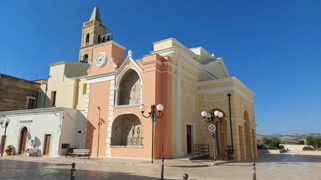
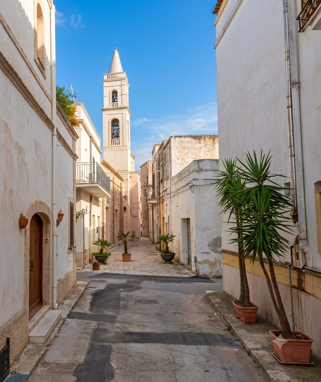
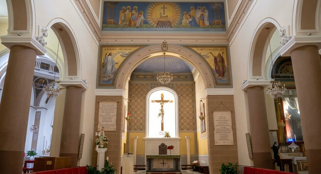
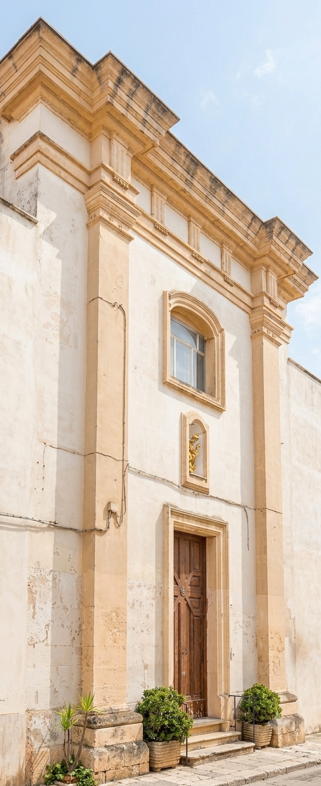
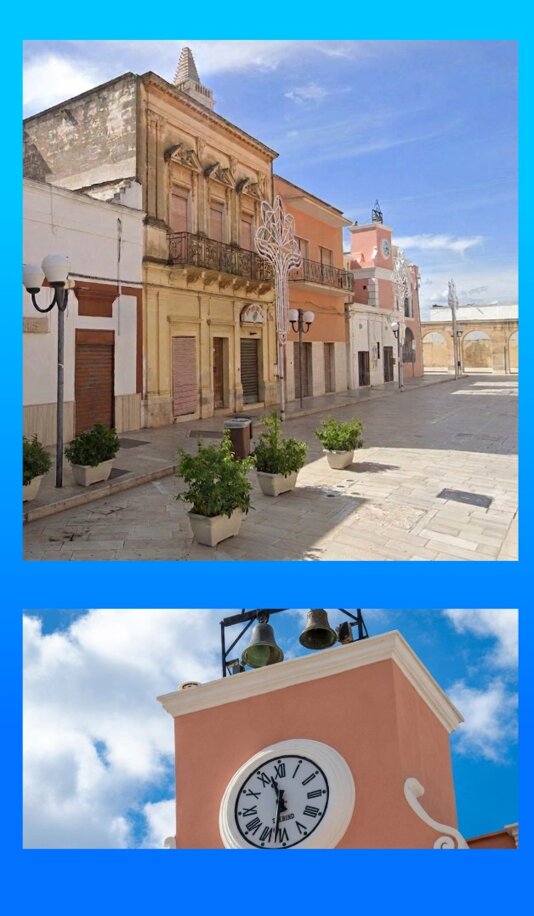
The historic center of Monteiasi is laid out on a compact, quadrangular plan centered around a main street. Its spiritual and architectural focal point is the Mother Church (*Chiesa Matrice*), dedicated to Saint John the Baptist; it was built in the early 17th century by the Ungaro family—Dukes of Taranto—with the support of Albanian settlers who initially practiced the Greek rite there. Originally, the structure consisted of a single nave with a wooden-beam ceiling and a reed-mat roof. Between the 17th and 19th centuries, the building underwent major transformations that defined its current form. An initial expansion took place in the second half of the 17th century, involving the opening of the rear wall to construct the apse and sacristy; this was followed at the end of the century by the creation of underground barrel-vaulted burial chambers, used for members of religious confraternities and the general population until the modern cemetery opened in 1844. The octagonal Chapel of the Blessed Sacrament was erected in 1824, while the right nave and the Chapel of the Crucifix were built three years later. The exterior also underwent radical changes over time. In 1834, the old 17th-century façade was replaced with a Neoclassical one; later, around the mid-20th century, a Classical-style *pronaos* (portico) was added to reinforce the façade, which had become structurally burdened by previous renovations. During this same period, the municipal chancery and the bell tower were built—the latter replacing an 18th-century *a vela* (gable-style) bell wall—while the barrel-vaulted roof was rebuilt in 1951 due to structural instability. Today, the exterior is distinguished by its imposing Neoclassical façade featuring a portico with massive pillars; the side elevation stands out for a large clock—originally installed in 1719—and two niches decorated with bas-reliefs. Inside, the church houses a precious Relic of the Cross, obtained by the Ungaro family from Pope Innocent XI in 1682; the Pope proclaimed the Crucifix the protector of Monteiasi.
Inside, there is a 17th-century chapel dedicated to Saint John the Baptist; commissioned by the noble Antoglietta family in the early 1600s, it is located on the left side of the entrance atrium and contains burial vaults. At the rear of the palazzo, a medieval load-bearing wall remains perfectly preserved; it dates back to the original structure once known as the "Masseria di Monteiasi," a place name documented as early as 1478. Another historic church in Monteiasi is the Chapel of the Confraternity of the Most Holy Sacrament and the Rosary. Also known locally as the ANSPI Oratory of the Holy Crucifix, this chapel is the spiritual heart of the centuries-old religious traditions and rituals that define the identity of the Monteiasi community. Inside the chapel stands a fine antique pipe organ—a precious example of local historical and artistic heritage—which frequently features in high-caliber concert series. The building is a typical 18th-century confraternity structure, situated just a short distance from the town center. Every October, the oratory hosts the start of the solemn celebrations. The statue of the Virgin is taken from the chapel and carried in procession to the parish church for her enthronement. The confraternity is the guardian of the Monteiasi "Procession of the Mysteries." This solemn event begins at the chapel, heralded by the distinctive, mournful sound of the *troccola* (or *trenula*). The territory of Monteiasi is particularly well-suited to nature-focused itineraries, such as the cycling route that traverses the surrounding countryside—characterized by expanses of centuries-old olive groves and vineyards, as well as historic structures like the Torre Masseria Teriesola on Strada Citrezze. The route winds through the evocative landscape of the Mar Piccolo Regional Nature Park, a biodiversity hotspot renowned for its *citri* (underwater freshwater springs) and the cultivation of the famous Taranto mussels. The area is home to seahorses, flamingos, and sites of historical and natural significance.
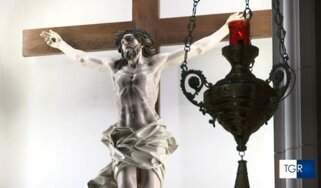
Notable among the artworks are three historic crucifixes; the most prominent is a wild pear-wood piece from the Neapolitan school, which arrived in 1682 and was placed in the apse, replacing an 18th-century papier-mâché statue of Saint John the Baptist (crafted in the Lecce style). The other two crucifixes—also dating from the 18th century but smaller in size—are kept in the sacristy alongside a 17th-century statue of the Immaculate Virgin. Located on the immediate western outskirts, Masseria Taverna stands as an important historical landmark, having served as a station for the Sovereign Military Order of the Knights of Saint John (the Knights of Malta). The structure was built on private land—overlying older foundations—sometime after the Order relocated its headquarters to Malta in 1525. This move shifted maritime routes toward the port of Taranto, turning the *masseria* (farmstead) into a crucial military outpost for defense, territorial control, and the collection of agricultural produce for the troops. Following the Battle of Lepanto in 1571 and the Knights' gradual withdrawal from outlying posts, the site was abandoned; the remaining farm laborers established a small hamlet there, which later came under the ownership of the Antoglietta family. Architecturally, the fortified complex comprises a church, storage areas, warehouses, an olive oil mill, and a garden—originally enclosed by a curvilinear wall, the foundations of which are still visible along the canal. The nearby Church of Barco della Taverna was also built by the Antoglietta family to serve as the farmstead's chapel. Both Latin and Greek rites were celebrated in this sacred space, with the latter led by Greek-Albanian priests, reflecting the area's significant population of Albanian settlers. During his pastoral visit in 1578, Archbishop Brancaccio described the church as a building with a single altar and walls adorned with frescoes of saints; it lacked a baptismal font and was independent of the Grottaglie parish for Latin-rite services. A short distance from the *masseria* stands the Ducal Palace, an imposing structure that towers over the surrounding dwellings, offering a panoramic view of Taranto and the Mar Piccolo.
RITES AND EVENTS
GASTRONOMY
GASTRONOMY
Second Part
First Part
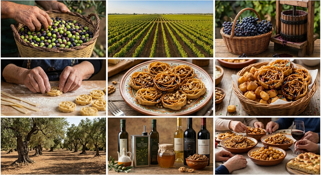
Excellent soil and climatic conditions—featuring fertile, mineral-rich alluvial soils combined with a typical Mediterranean climate—foster the production of high-quality agricultural goods appreciated well beyond the region's borders. Olive growing in Monteiasi blends the heritage of centuries-old trees with modern cold-extraction techniques. Standout varieties include Oliarola and Frantoio, prized for their resilience and excellent organoleptic qualities. The local extra virgin olive oil is distinguished by very low acidity, a golden hue with green highlights, and a perfect balance of fruity, bitter, and peppery notes. Situated in the heart of Primitivo country, Monteiasi boasts a strong winemaking tradition involving both table grapes and wine varieties such as Negroamaro and Malvasia Nera. The local valleys' soil composition—a mix of clay, sand, and limestone—ensures ideal drainage for vine roots, concentrating sugars and aromas in the grape clusters. The resulting wines are warm, full-bodied, and aromatically intense, renowned for their remarkable longevity and robustness. Traditional pastries are often linked to religious observances—such as *struffoli* and *cartellate* at Christmas and *scarcelle* at Easter—but the *Anello di San Cataldo* is not to be missed: a rich almond shortcrust ring filled with pastry cream and sour cherries, topped with puff pastry and caramelized almonds.
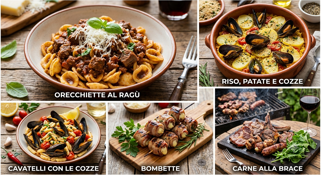
Monteiasi’s signature dishes blend the traditions of Puglian peasant cuisine with the rich flavors of the nearby Taranto area, drawing from both land and sea. Traditional first courses include homemade *orecchiette* dressed with a thick, flavorful horse-meat sauce; *cavatelli* with local Taranto mussels; *riso, patate e cozze* (rice, potatoes, and mussels)—one of the most iconic dishes of Puglian cuisine, strictly oven-baked in a round pan known as a *tiella*; and fava bean purée, traditionally served with wild chicory or accompanied by peppers and potatoes. Standout main courses include meat specialties such as *braciole* (meat rolls) filled with garlic, parsley, and cheese, and slow-cooked in tomato sauce; *nghiemeridde* (or *fegatini*), rolls of lamb offal wrapped in casings and either grilled or stewed; and *bombette* and charcoal-grilled meats typical of local *bracerie* (grill houses). *Focaccia* and *taralli* are classic artisanal baked goods made with local extra virgin olive oil, alongside fried *panzerotti* filled with mozzarella and tomato. Dairy products are also renowned, particularly *pampanella*—a fresh, delicate cheese made from cow’s or goat’s milk that was traditionally flavored by being wrapped in a fig leaf (*pampino*). Once a classic street food found on Taranto’s beaches, it is now eaten with a spoon, as health regulations have altered the way it is served.
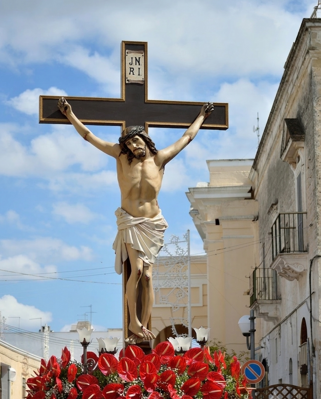
In Monteiasi, the main patronal festival is dedicated to the Exaltation of the Holy Cross (or the Holy Crucifix) and takes place on September 14th. The community celebrates the event with a rich program blending faith and folklore, featuring prayer triduums, a solemn procession through the town streets, and a traditional schedule of secular festivities including illuminations, band concerts, and fireworks. The celebrations center around the Parish Church of San Giovanni Battista. In addition to the September event, another deeply felt and well-attended festival takes place in early May, also dedicated to the Holy Crucifix (historically known as "*Lu Crucifissu Piccinno*"). During the patronal festival, the Mayor performs the ritual of symbolically handing over the town's keys to the Holy Crucifix. Throughout the festival days, the air in the historic center fills with the aroma of food stalls, and the market stands lining the streets always offer "*copeta*"—a local almond brittle made with whole almonds and hot caramelized sugar, cut to order on marble slabs—and "*intorchiate*," a local braided biscuit topped with whole almonds and sugar granules. Another religious observance deeply cherished by the community is the Feast of Our Lady of the Rosary. Held annually during the second week of October, it combines solemn moments of prayer with secular and musical events. During the solemn procession, the statue of the Virgin Mary is carried through the town's historic streets, accompanied by the faithful, the local Confraternity, and the music of marching bands. The festivities conclude, as is tradition, with a grand fireworks display. The main and most recent food and wine event is the *Sagra della Frisella* (Frisella Festival)—now in its fourth edition—an occasion entirely dedicated to celebrating this baked product typical of Puglian cuisine. Numerous food stalls, traditional markets, and local artisan displays are set up along Via Roma. The *friselle* are dressed in both classic and creative ways, offering an excellent opportunity to taste local extra virgin olive oil and wine. The evening features live music and spectacular performances. The *Festa Pro-ANT*, now in its 17th edition, takes place annually in early July in Piazza Papa Giovanni XXIII. Although it is a charitable event supporting the ANT Foundation (National Cancer Assistance), it is a genuine community festival with a strong culinary focus, featuring local food stalls, beer, and four consecutive nights of major concerts with tribute bands and DJ sets
MAPPEDITALIA SOCIAL
Mappeditalia.it © Tutti i diritti riservati