

HISTORICAL INFORMATION
NATURE AND LANDSCAPE
HISTORY AND LITERATURE
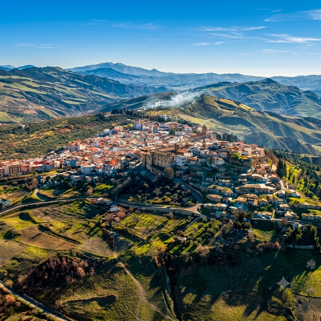
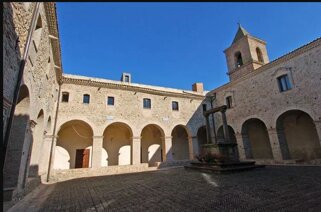
Salandra stands on a hill at an elevation of approximately 598 meters above sea level, in a position overlooking the Salandrella-Cavone valley. The name Salandra has ancient origins and likely derives from a Greek place name linked to the nearby Salandrella watercourse—known in ancient sources as the Acalandro or Acalandrum. A second hypothesis points to *Calandra* (*Alauda cantrix*), a bird related to the lark; this species is documented in the area and was likely depicted on the town's original coat of arms. The earliest traces of human presence date back to the period between the Iron Age and the Hellenistic-Lucanian era, with evidence found at various sites such as Madonna del Monte, Monte Sant’Angelo, Serra d’Ulivo, Piana S. Giovanni, S. Vitale, and Mesola Lunga. A new and intense phase of settlement occurred during the medieval period with the establishment of the current town center under Norman rule. The remains of the Norman castle and the Mother Church of the Most Holy Trinity (*Chiesa Madre della Santissima Trinità*), both located in the historic center, date back to this period. Towards the end of the 15th century, the history of the Salandra fiefdom became closely linked to the fortunes of the Aragonese dynasty, and from 1544 until the early 19th century, it was associated with the Revertera family. One of the family's most significant undertakings was the construction of the Franciscan Reformed Fathers' monastery—located just outside the town and now serving as the municipal headquarters—along with the adjoining Church of St. Anthony of Padua.
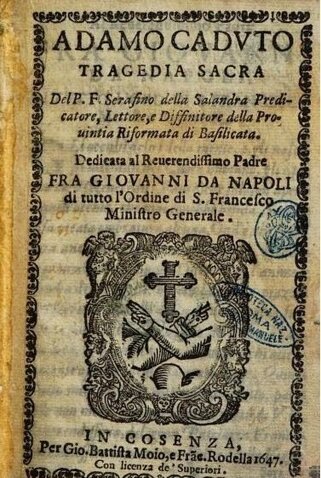
The religious and social life of the 17th-century community of Salandra was shaped by a distinguished figure: Father Serafino. Born in Salandra in 1595, he was educated at the local monastery of San Francesco; between 1644 and 1647, he was elected *Definitor* and *Custos* of the Franciscan Order for the entire province of Basilicata. A tireless preacher, he traveled extensively—from Potenza to Cosenza and from Matera to Naples, where he died of the plague in 1656. His most famous work is the sacred tragedy *Adamo Caduto* (The Fallen Adam), a five-act play centering on the themes of original sin and the expulsion of Adam and Eve from the Garden of Eden. Many scholars maintain that this work was one of the primary sources that inspired John Milton’s *Paradise Lost*.
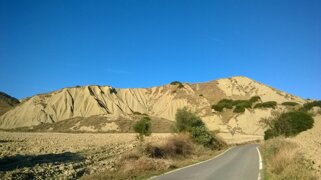
The territory of Salandra offers diverse and striking landscapes: the terrain shifts from barren clay hills sloping down toward the Salandrella stream to cool, wooded areas. Various vantage points in the historic center and the local road leading to the "Cavonica" provincial road reveal a lunar landscape defined by dramatic badlands (*calanchi*). The countryside surrounding the village is characterized by olive groves and orchards, while more distant areas are covered by over 1,000 hectares of dense forest, consisting primarily of oak species (Turkey oak, downy oak, Hungarian oak) and secondary shrubs (wild service tree, blackthorn, flowering ash). The Materi forest and the Montagnola area are ideal for nature walks, offering precious moments of pure relaxation.
TOURIST ROUTE
TOURIST ROUTE
TOURIST ROUTE
First Part
Second Part
Thirth Part
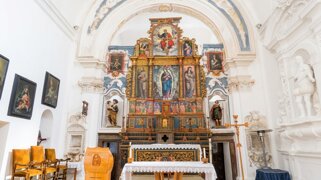
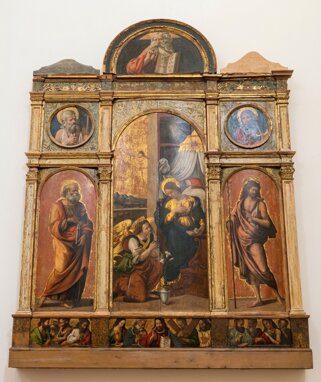
Salandra boasts a rich artistic and architectural heritage. The main monuments are located around Piazza San Rocco, the hub of city life. The first is the former Convent of the Reformed Franciscan Fathers with the adjoining Church of St. Anthony of Padua. The church, set back from the rest of the structure, is accessed through an archivolted portal, framed by semi-columns supporting a flat entablature. The architrave bears an inscription in capital letters, dating the religious building's opening to the public to September 1573. The façade is decorated with limestone statues in three niches above the architrave, likely from the Byzantine era, of St. Anthony, St. Francis, and Christ the Redeemer. The portal is flanked by two stone lions, in Saracen style, likely reused. The interior, with a single nave, is enriched by precious paintings and sculptures from the 16th, 17th, and 18th centuries, some of inestimable artistic value. First among these is the triptych of the Annunciation, a masterpiece by Simone da Firenze, a renowned 16th-century painter, originally an altarpiece for the rural church of the Annunziata. The central scene of the Annunciation with the Virgin and the Archangel Gabriel is framed by other depictions: the Eternal Blessing above; St. Peter on the left; St. John the Baptist on the right; the latter surmounted by two half-length saints (St. Jerome and St. Paul); below is a tripartite predella depicting Christ and the Twelve Apostles. The high altar is dominated by the precious polyptych by Antonio Stabile (1569-1584) from Potenza. It is divided into thirteen sections decorated with vines and gilded columns, which in the center frame the paintings of St. Francis, the Immaculate Conception, and St. Clare. In the upper register, paintings depicting the Archangel Gabriel, the Trinity, and the Annunciation can be seen. Mirroring the altar is the choir, which houses one of the oldest Renaissance organs dating back to 1570. It features a five-bay soundbox, bordered by an arabesque-patterned architrave with a cornice, on which is written “[…]US MEUM LEV[…]”. The Revertera coat of arms, depicting a shield with three blue bezants between two horizontal red bands, is present on the front of the soundbox and constitutes an important document of the ties between the Spanish dynasty and the monastic community of Salandra; a connection also confirmed by the presence of a plaster statue of Duke Francesco Revertera to the right of the altar. The ancient monastery of the Friars Minor of the Observance, built around 1542/46 by concession of Pope Paul III and by will of both Duke Revertera, lord of Salandra, and the community of Salandra. In 1593, the convent passed to the Reformed Franciscan Fathers.
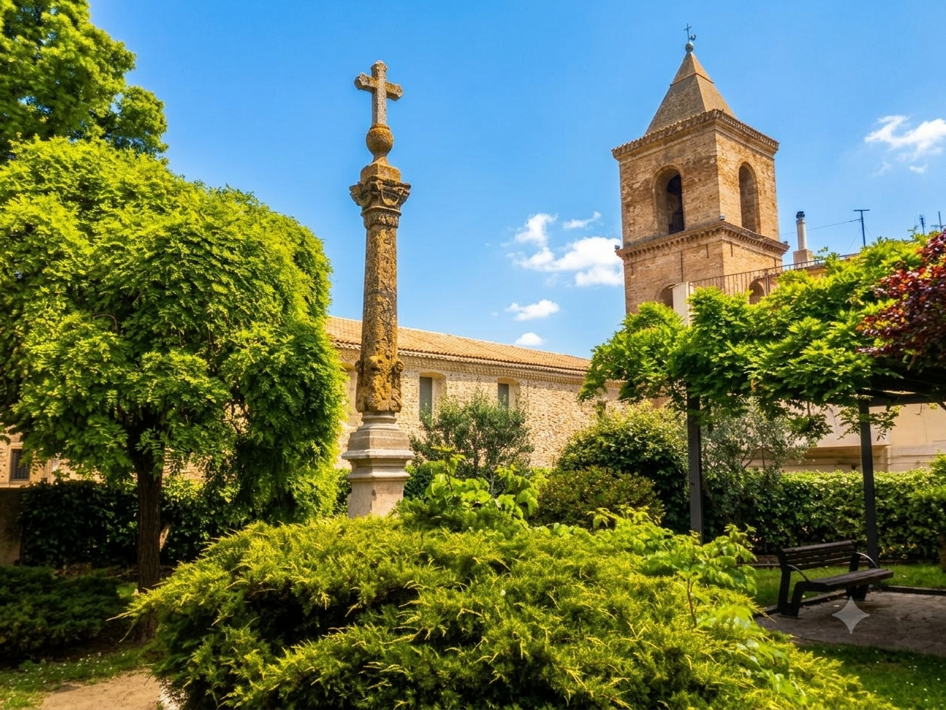
The Fresco Room, originally the convent's refectory, overlooks the evocative cloister. Here, you can admire a splendid fresco by an unknown Lucanian painter. The central panel depicts the Deposition of Christ from the Cross, in the presence of the Madonna and the three Marys. The two lateral panels depict Saints Francis and Anthony of Padua. The cross located in the town park belongs to the convent. The green heart of the village, the park, built around 1948, remains a meeting place and a place of refreshment, especially in the summer. The Church of San Rocco, home to the parish of the Holy Trinity of Salandra, dedicated to the patron saint of Salandra, overlooks the main square. It was built in 1656, the year of the plague epidemic that severely affected the Viceroyalty of Naples. It was expanded in 1843 and opened to the public three years later. Externally, it features an imposing façade divided into three sections by semi-pillars set against the walls. The interior is also divided into three naves, punctuated by large pillars with Corinthian capitals. These support a long architrave and a barrel-vaulted ceiling with lunettes. At the end of the central nave are the presbytery and the semicircular apse, covered by a dome with four lunettes decorated with frescoes of the Four Evangelists, the work of the artist Cosimo Sampietro da Massafra. This church is also embellished with a rich repertoire of sculptures and paintings dating back to the 17th, 18th, and 19th centuries. The choir loft, supported by two polychrome wooden columns with Ionic capitals and decorated with a frieze depicting a lyre held by two winged cherubs, houses an 18th-century organ. The historic center occupies the highest part of the town, overlooking the surrounding valley. Not far from the religious building is the Church of Santa Lucia, formerly Santa Maria della Neve. Of the ancient medieval village, made up of alleys, small squares, private churches (Chapel of Santa Maria Larabita), noble palaces, and modest homes, only the ruins of the Norman Castle and the Mother Church of the Holy Trinity remain. The latter, built between the 11th and 12th centuries, has suffered extensive damage over time from powerful earthquakes. In 1857, following the partial collapse of the building and the bell tower, it was decided to rebuild the façade and only part of the bell tower to prevent further natural disasters from compromising its stability. The church, in Romanesque style, features a flat brick entablature on the façade, supported by two semi-pillars that frame the wooden portal decorated with the symbol of the
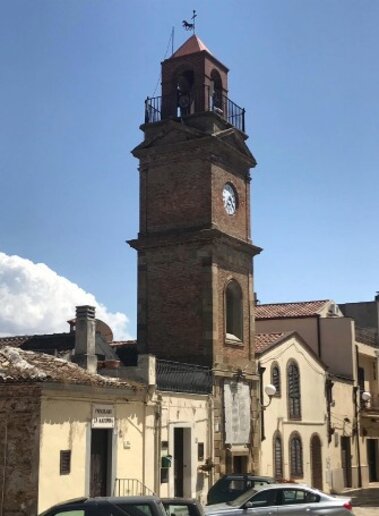
Trinity: a triangle with the all-seeing eye of God inside. The church is divided internally into two naves: the main nave leads to the high altar from 1751, the work of the sculptor Antonio De Lucca from Naples, and the left lateral nave, which ends in the chapel of the Sacred Heart. The apse boasts an imposing painting of the Trinity, with the figures of the Father, Christ the Son, and the dove of the Holy Spirit. Beneath the presbytery are the remains of a crypt decorated with Byzantine frescoes and featuring a small altar. The main entrance to the village was through the so-called Porta Nuova, located in Piazza Guglielmo Marconi. Built of a mixed brick and stone wall, it has a rectangular plan covered by an intricate system of pavilion vaults. The ancient city walls, of which the gate is the only architectural vestige today, almost entirely surrounded the medieval village and were likely equipped with several lookout posts for the defense and control of the surrounding territory. Piazza Marconi, built after the 1857 earthquake, hosts numerous cultural events in its intimate spaces; its life is marked by the chimes of the clock. The Clock Tower, approximately 20 meters high, is made of a sturdy brick and stone block structure, with a quadrangular plan and divided into three sections by stringcourses. Below, above the entrance door, is a plaque commemorating the fallen of the First World War, which corresponds, above, to a single-lancet window with a round arch. On the third floor is the clock, framed by two brick half-pillars, while above stands the aedicule with the bell, entirely rebuilt after the 1980 earthquake. Outside the city limits are the Church of the Annunziata and the Sanctuary of the Madonna del Monte. The latter, mentioned as the "Monastery of Santa Maria de Cornu" in the papal bull of 1183 by Pope Lucius III, stands approximately 100 meters above sea level. 7 km from Salandra, within a green area with centuries-old oak trees and olive groves. The church dedicated to the Virgin was built in the early Middle Ages and expanded in 1800. Rectangular in plan, its façade features a wooden portal with a brick architrave and a bell tower with a "knight" shape. Inside, it has a single nave with a barrel vault and lunettes, and in the apse, it preserves some fragments of a Byzantine-style fresco. Next to the building, archaeological excavations have identified the remains of a second, smaller church. It had an open apse on the east side and a small entrance to the north. The tombs, in tiled coffins, dating to the 6th and 7th centuries AD, were located around it.
RITES AND EVENTS
SPORTS FACILITIES
GASTRONOMY
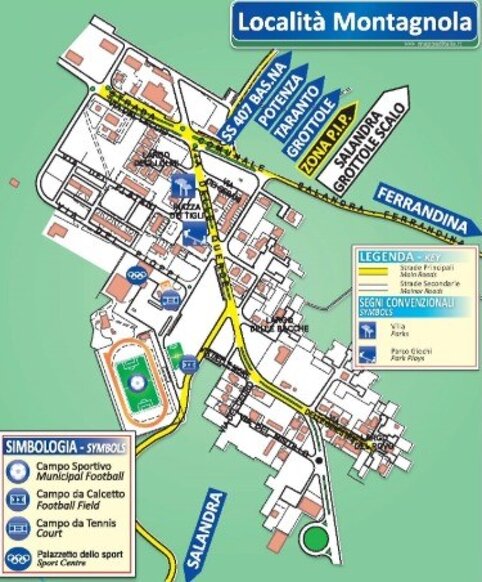
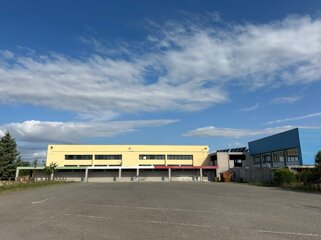
A few kilometers from Salandra, the hamlet of Montagnola, founded in the 1970s in the wooded area of the same name, is a residential area and home to a major sports complex consisting of the "Marco Saponara" sports hall and soccer fields. In Varre, closer to town, there are soccer fields, tennis courts, and basketball courts, while speed enthusiasts can try their hand at go-kart racing and motorcycle rides at the Kartodromo located along the Salandra-Grottole provincial road.
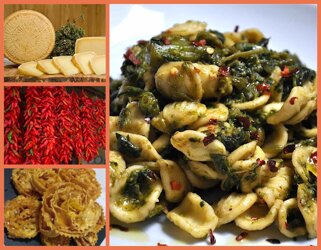
Typical Salandrese cuisine is an explosion of intense flavors and aromas. The dishes tell the story of the town through the combination of ancient culinary traditions and the simple flavors of the land. 'A pasturalë (a mutton stew with vegetables and herbs, slowly cooked in a terracotta pot called a pignata), boiled potatoes and fried cruschi peppers, fafe e fògghië (broad beans and wild chicory), tripe with potatoes, and fresh pasta (orecchiette, cavatelli, etc.) with turnip tops and chili pepper, or with fresh sausage or chickpeas (sagnëtèddë and cécërë) are just a few typical dishes rooted in the peasant and pastoral culinary traditions of Basilicata. Salandra also boasts an ancient tradition of pork processing, centered on the production of cured meats (sausage, capocollo, pancetta, etc.) and goat's milk for cheese production. During the holidays, traditional desserts such as ricotta or chickpea cream parcels, pettole, crëspeddë or chiacchiere, ricotta focaccia, and much more are enjoyed, sealing moments of conviviality right from the moment they're prepared.
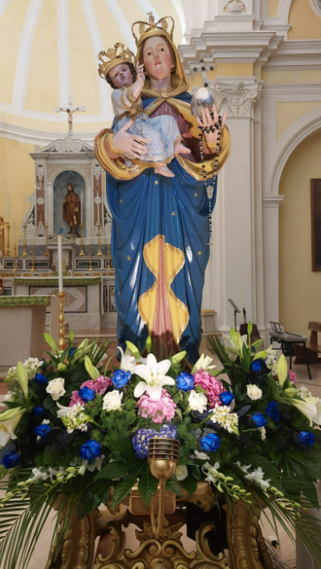
The calendar of festivities begins in January with the celebration of Mass in honor of Saint Anthony the Abbot and the traditional Campanacci parade. The sound of cowbells echoes through the town streets from the first light of dawn as propitiatory symbols to attract good luck, prosperity, and fertility. This is followed by the rites of Holy Week and Corpus Christi, and then continues into May. The last Sunday of the month marks the country festival in honor of the Virgin Mary, deeply felt by the people of Salandro (and beyond), which takes place in the sanctuary of the Madonna del Monte. According to legend, the spot, nestled in the woods, was chosen directly by the Madonna, who appeared to a shepherd in the trunk of one of the centuries-old oak trees that characterize the area. The festival begins on Saturday with the procession of the statue of the Madonna through the town streets and the solemn Mass in Montagnola. After accompanying the Madonna to the sanctuary, the town awaits the arrival of Sunday. The entire day unfolds around the small rural church, punctuated by moments of prayer and recreation: stalls, refreshments, illuminations, and games enliven the place until late in the evening, awaiting the fireworks display. Another eagerly awaited event for the local community is the patron saint's day in honor of San Rocco, which falls on August 16th, 17th, 18th, and 19th. The festivities combine religious rites and cultural events, culminating in the solemn processions of San Rocco "Vecchio," linked to the rural world, and San Rocco on August 18th. The statue of the patron saint, adorned with votive offerings, is carried through the streets of the town in a participatory manner. The evenings are enlivened by band concerts, theatrical and musical performances, and conclude with fireworks displays that light up the sky above the cellars. An unmissable event is the Storie Parallele Film Festival in September, which offers the town intense days dedicated to documentary cinema, meetings with national and international artists, and workshops for children and young people.
MAPPEDITALIA SOCIAL
Mappeditalia.it © Tutti i diritti riservati