
THE CONSPIRACY OF THE BARONS
HISTORICAL INFORMATION
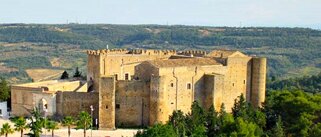
MALCOSIGLIO CASTLE
The Barons' Conspiracy was a major conspiracy and revolt that took place in the Kingdom of Naples in the second half of the 15th century, primarily against King Ferdinand I of Aragon, known as Ferrante. Its most intense phases were the First Barons' War (1459–1464) and especially the Great Conspiracy of 1485–1486. The southern barons, the major feudal lords of the Kingdom, joined forces against the Aragonese king Ferrante I. The causes that triggered the Conspiracy were: Ferrante I's attempt to limit the excessive power of the barons (who owned vast fiefdoms and exercised almost unlimited authority) in order to strengthen the central power of the Crown; the barons' support for the return of the Angevins to the throne of Naples, in opposition to the Aragonese; and the support for the revolt by the Papal States (particularly Pope Innocent VIII). After an initial clash (1459–1464), the conspiracy regained strength in 1485, with barons such as the Prince of Salerno, Antonello Sanseverino, and other powerful families. After several military clashes and an apparent truce, Ferrante I acted with cunning and violence: he invited the leaders of the conspiracy (including the Sanseverinos, the Duke of Melfi, and even his secretaries, Antonello Petrucci and Francesco Coppola, suspected of treason) to a banquet and a peace meeting in the Castello del Malconsiglio in Miglionico (Basilicata, in September 1485). Treacherously, the king had the conspirators arrested and had them imprisoned and executed in the following years. This resulted in the confiscation of the rebel barons' assets and their execution. This temporarily strengthened the power of the Aragonese Crown over the Kingdom of Naples, reducing the influence of the most powerful and autonomous barons. Today, the Barons' Conspiracy is also commemorated in historical events, particularly in Miglionico (Matera).
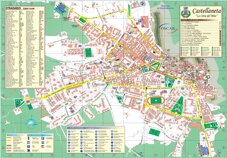
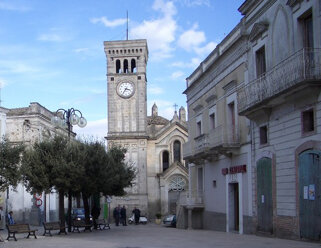
Miglionico is located in the eastern part of Basilicata, in the province of Matera. It sits on a hill between the Bradano and Basento rivers, 465 meters above sea level. Malconsiglio Castle, the second oldest castle in Basilicata, dominates the view from the hill. The town is known for the events linked to the Castle, where the Conspiracy of the Barons against King Ferdinand I of Naples (1485) took place. It is also affiliated with the National Association of Olive Oil Cities, an organization that promotes and enhances extra virgin olive oil and its production areas. The San Giuliano regional reserve lies within its territory, as the right bank of the Bradano River and Lake San Giuliano partly belongs to the municipality. It is also known for the winding climb that leads to the town. Miglionico's origins are remote, likely dating back to an Enotrian civilization, as evidenced by tombs and vases dating back to the 6th century BC found in its territory. According to tradition, it was founded by Milo, from whom the city also derives its name. He was a famous athlete from Croton in the 6th century BC, victorious in the battle against Sybaris, and called an Olympian because he was a multiple victor as a wrestler in the Olympic Games. Another interpretation, however, holds that the true founder was Milo of Taranto, a lieutenant of Pyrrhus who also took part in the Battle of Heraclea. Arriving in the hills between the Bradano and Basento rivers, he founded a military colony, calling it Miglionico. Milo built large walls, as the phrase "Milo Magnus Miles Me Munivit Magnis Muris" (Milo Magnus Miles Me Munivit Magnis Muris) suggests, represented by the seven initial Ms on the municipal coat of arms. Miglionico is also nicknamed Napulicch (little Naples), perhaps after a citizen who, wishing to name his town after a capital, asked this favor of the King of Naples, who granted it, jokingly calling the town Napolicchio. After the Greek colonization, it became a Lucanian city, then passed under the Samnites until 458, the year in which it was conquered by the Romans.
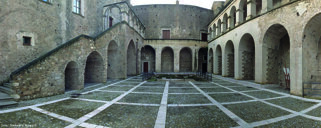
Malconsiglio Castle plays a significant role in Italian history. It occupies a strategic position atop a hill overlooking the entire Bradano Valley, perched on isolated rocky terrain known as Cencre. The castle dates back to the 8th-9th centuries AD. Count Alessandro of Andria built the upper floor in 1110. The Lords of the Castle: • 11th-11th centuries: The Counts of Andria; • 1415: Sforza de Attendolis; • 1449: Antonio Sanseverino, Prince of Bisignano; • 1487: Giovanni Nauclerio; • 16th century: The Sanseverino family (who reacquired it after the expulsion of the Aragonese from Naples); • Ettore Fieramosca, champion of the Challenge of Barletta; • 1624-1829: Ippolito Revertera of the Dukes of Salandra; • 1861: State property (it was privately owned until 1992, when the Municipality initiated expropriation proceedings, allowing restoration work to begin). It has the shape of a parallelogram, flanked by seven towers, some square (the oldest), two twin towers, and others circular, placed at the corners of the building. These are the result of one of the many renovations and renovations the building has undergone over the centuries. After the unification of Italy, the Municipality of Miglionico, which had acquired the castle, divided it into lots, selling it to private citizens who converted it into residential units. Fortunately, this important building has returned to public ownership. The current entrance gate faces northeast, while the original one, destroyed by the 1857 earthquake, was adjacent to this one and faced south. Of the old gate, the small pillars with carved stone architraves can still be seen, containing the remains of two stone tigers with the Bisignano baronial coat of arms. It features a tilted shield with a band bearing a mane, and a lowered medieval helmet, from whose top protrude two large bovine horns, symbolizing fortitude and victories in tournaments. In the castle's inner atrium is the ancient well, as large as the courtyard, which collected rainwater for the entire town. A long, wide staircase leads through a narrow, pointed Teutonic door to the upper floor, where the lords' quarters, the androecium, the regents' quarters, and the government rooms were located, including the Hall of Malconsiglio, whose floor collapsed during the 1857 earthquake. The lords could also access the androecium's rooms on horseback, given the width of the stairs and doors. The entire loggia of the androecium was built in the 1400s. The most beautiful part of the castle is the Hall of the Star, or Hall of the Spirits, from which one can admire the panorama of the surrounding valleys. The room was used to store important documents and, above all, gold in its numerous carved niches. It was also called the Hall of Spirits to discourage anyone who might intend to steal. The room is noteworthy for its architectural beauty. The star-shaped ceiling is, in fact, similar to those found in the Martorana in Palermo. The Hall of the Star was the most secret part of the castle, accessible only to loyal followers. It was also the most fortified and defended. It was here that the law of the first night was practiced. Every bride had to spend her first wedding night with the baron. It was possible, however, for the groom to appear in place of the bride, dressed in women's clothing. On one such occasion, a baron was massacred and killed in a room near the castle, which was known as "The Baron's Shame." The Sala della Stella led directly to the Salone del Malconsiglio, where the Barons' Conspiracy was held in 1485: a reactionary movement that developed in the 15th century, primarily in Basilicata, as a reaction to the Aragonese who had established themselves on the throne of Naples. The loggia leading to the hall from the outside dates back to the 18th century, while the walkway is much older, dating back to the 15th century. The women lived in the harem (formerly inhabited by the Stancarone family). The harem had low doors, as did its entrance door. The manor housed three main construction phases (the first dating back to before 1000, the second to 1110, and the third to the 1400s), as can be seen by walking around the building. During recent restoration work, traces of the Pelasgian civilization of the 10th-8th centuries BC (populations from the East, Umbria, and the Marche) were discovered in some rooms. These are perhaps structures that served as storage areas for grain, oil, or food supplies in general.
TOURIST ROUTE - FIRST PART
TOURIST ROUTE - SECOND PART
TOURIST ROUTE - THIRD PART
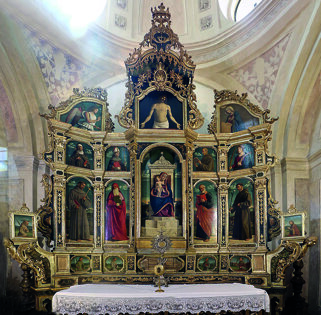
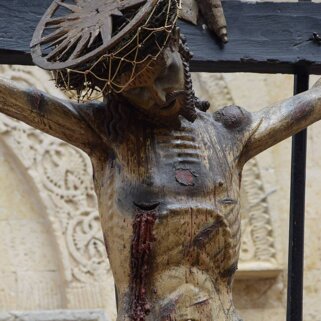
The Mother Church of Santa Maria Maggiore, dedicated to the Assumption, has been a Pontifical Basilica since 1051 and served as a Cathedral for several centuries when the Pope, in the dispute between Matera and Acerenza, chose Miglionico as the episcopal seat because it was located halfway between the two territories. Of great value within the Basilica is the Polyptych by Cima da Conegliano, a splendid work dating back to 1499 and consisting of 18 panels enclosed in a majestic poplar frame. According to local tradition, Don Marcantonio Mazzone, a parish priest and scholar, purchased the work in Leipzig in 1598 to place it in his parish. At the center of the Polyptych is the "Madonna Enthroned with Child"; on the sides, full-length figures, are Saints Francis of Assisi, Jerome, Peter, and Anthony of Padua; in the upper tier, half-length figures, Saint Clare, Saint Louis, Saint Bernardino, and Saint Catherine of Alexandria; in the cymatium, Christ Passing between the Annunciation and the Announcing Angel; finally, in the predella, the Franciscan Protomartyrs. The central panel of the predella, which may have depicted the Nativity, is missing. In 1782, after its dismemberment, the Polyptych was reassembled in its current frame by a noble family from Miglionico, who added their coat of arms to the lower right panel. In 1907, the scholar Martin Wackernagel, comparing the Polyptych with the Dragan Altarpiece (Madonna of the Orange Tree) in the Galleria dell'Accademia in Venice, circa 1496, attributed it to Giovan Battista Cima da Conegliano. The Polyptych has undergone restoration several times. Inside, we can also see several paintings, including one by Tintoretto from 1580, depicting the Madonna Assumed into Heaven, and one by Guercino; a Crucifix from 1529 created by the Franciscan Father Umile da Pietralia. Mel Gibson, actor and director, used the face of Christ on this Crucifix in his film, "The Passion," shot in Matera; and the large 16th-century Baroque organ, composed of 321 pipes, recently restored. The Church of Santa Maria delle Grazie was rebuilt by Count Ettore Fieramosca, who commissioned Giovanni Antonio Bazzi, known as Sodoma, to fresco part of the church. However, the latter, who was employed by the Pope, could not work for others and so signed his work, a fresco of the Nativity of the Virgin Mary, with a cat in a white cloak (the Pope) and a mouse, representing Sodoma himself, who would be eaten by the cat if he did not leave Miglionico immediately. Sodoma also painted a fresco in the church of Santa Chiara in Naples in this manner. Other noteworthy frescoes include a statue of the Madonna delle Grazie by Altobello Persio, and a small 16th-century organ. The Evangelical Baptist Christian Church, located in the historic center, was founded by a priest, Carlo Laterza, who, having become an evangelical, began evangelizing the city in the late 1880s. For several years, he organized the small group, holding meetings in various homes as chance permitted.
Among the converts was an army sergeant major, Carlo Piccinni, who wrote to the Opera Battista of his intention to establish a Baptist church, proposing himself as an evangelist and leader of the group in 1890. The Convent of San Francesco was built by order of Prince Sanseverino in 1439 on the site of the old Lombard castle of Santa Sofia. On the internal walls of the chapel of the same name are painted valuable frescoes created by the students of Giovanni Todisco. The town hall of Miglionico, a few years ago, was housed in the old Franciscan convent, next to which is the church of San Francesco, closed for worship after the earthquake of 5 May 1990. During the restoration works, which began in 1999, the body of Father Eufemio da Miglionico was found and subsequently buried in the Mother Church of Santa Maria Maggiore (1999). Miglionico's most important musician, Don Marc'Antonio Mazzone, was born in the house owned by Bonaventura Asprella, inhabited by the family of the late Nicola Ventrelli, in a large convent. On the façade of the house is a niche containing a small statue. He lived between 1556 and 1626. A well-known organist in northern Italy, he also lived in Mantua and Venice. He composed, among other works, a Magnificat. The other local musician, Francesco Stabile (1801-1860), was born in the so-called "old barracks." On the small road that leads behind the former convent is the Porta Suillina. Returning from the East, where he had defeated Mithridates, king of Pontus, Sulla passed through Miglionico, traveling along the Appian Way, on his way to Rome to defend his interests. Pyrrhus, king of Epirus, wintered on the Pian dell'Oste hill during the war between Rome and Taranto (282 BC). A kitchen set and elephant tusks were found there, and are now in the Domenico Ridola Museum in Matera. The entire complex of the former convent was once a Norman castle: the Castle of Santa Sofia. In 1456, it was assigned to the Franciscan friars and was the only convent within the town walls. Just before the former slaughterhouse, on the right, are some walled-up arches that were the castle's prisons. When a person was arrested, they were placed in the lowest prison (lower arch); when sentenced to death, they were placed in the highest one (upper arch), where they were left to die alone, without the possibility of interacting with other people. Near the door of the former slaughterhouse, there is an icebox. When it snowed, the monks piled up a lot of snow, layering it with straw as well. The ice would last until summer. The Franciscans, when needed, distributed the ice to residents who requested it. The Church of the Madonna della Porticella stands on a hill overlooking the Bradano and Basento valleys; it is the site of a country festival celebrated on the second Sunday of September and attracts large numbers of devotees from both Miglionico and neighboring towns.
THE ANCIENT TOWERS
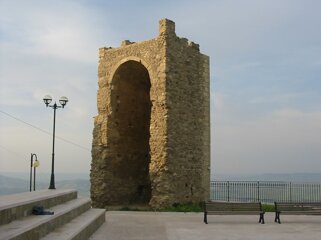
From the ancient walls that once surrounded the town, numerous towers are still visible; one of these is the Torre di Fino, so named because the town ended there, and was a watchtower overlooking the Bradano Valley. Several other medieval towers are also visible. From this strategic position, it was possible to observe the towers of the medieval castle of Miglionico and those of the castle of Santa Sofia. After World War II, the surrounding walls adjacent to the tower were demolished. However, on September 19, 1976, a flood caused a landslide in the area of the tower, revealing a necropolis from the 6th century BC. Significant artifacts were discovered within the necropolis, including vases, bronze objects, and military, feminine, and infantile ornaments. These archaeological treasures are now housed in the "Domenico Ridola" National Archaeological Museum in Matera. The Fino Tower is not only a place of historical interest, but also a symbol of the region's evolution, from ancient times to the present day. Miglionico offers numerous nature trails in the surrounding area for nature lovers, hikers, cyclists, and motorcyclists. Not far from the village, in fact, lies the San Giuliano Oasis. The San Giuliano Regional Reserve is the largest nature reserve in the entire province. The reservoir was formed artificially and is one of the most important lakes in Basilicata. It is an area of community interest and a special protection zone, especially for birdlife. Furthermore, the entire area of the San Giuliano dam has been listed as a wetlands of international importance for aquatic fauna. Since 1976, this reservoir has been declared a regional nature reserve, and since 1989, it has been recognized as a WWF Italy Oasis. Hunting is naturally prohibited in the area, and birdwatching and historical and environmental excursions are permitted. The vegetation around the lake is hygrophilous, consisting mostly of poplars, willows, and tamarisks; while trees such as Aleppo pine are distributed along the perimeter, helping to prevent hydrogeological instability. The park is equipped with picnic and play areas, with activities suitable for children. In 2006, a shepherd found the fossil of a whale on the shores of the lake: "The Julian Whale," the largest whale fossil ever discovered in the world. This fossil, dated to the Lower Pleistocene (about 1.5 million years ago), was a marine animal that swam in the Mediterranean, and its discovery has provided crucial information on the evolution of gigantism in whales. It is exhibited and studied at the Domenico Ridola National Archaeological Museum in Matera.

GASTRONOMY
RITES AND EVENTS - FIRST PART
RITES AND EVENTS - SECOND PART
Miglionico's age-old culinary tradition enhances the flavors of products considered "poor," yet they offer unmistakable tastes, thanks to the use of natural and simple ingredients, expertly balanced. These local products preserve the flavors and aromas of times gone by. The full-bodied, bold extra virgin olive oil enhances traditional dishes made with fresh, homemade pasta (Càpùnd, R'cchìtèdd, and Affr'cièdd). The oil is also used to prepare special taralli, crispy and flavorful. Miglionico's flagship product is undoubtedly the fig, especially dried figs, with or without almonds. Once harvested, the figs are dried whole in the sun according to an ancient practice; they are then split and reassembled, after being filled with almonds, lemon zest, and other secret ingredients. After a long and elaborate process, cooked ripe figs yield a thick, sweet nectar (cuòtt), which is still used today to flavor various traditional culinary specialties. Miglionico recently obtained PAT (Traditional Agricultural Products) certification for its famous dried figs. This certification adds value to local production, supporting the fig festival and the flavors of autumn, while also offering an opportunity to enhance the Lucanian village's tourism offerings. The vineyards, cared for with passion, produce excellent wines. Culinary specialties are tied to religious holidays. During Easter, a savory pie filled with sausage, eggs, and "Culumbrèdd" cheese is prepared. At Christmas, people enjoy the traditional “Pettole” and the small “P’rcièdd” (pieces of pasta with fennel seeds fried in olive oil) and the fragrant “C’rspèdd” (thin strips of fried pasta), seasoned with honey or cooked figs.
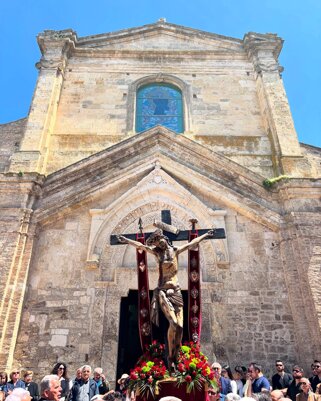
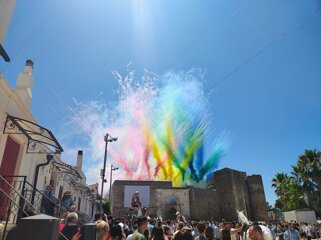
Easter rites are deeply felt. Combining faith with the valorization of the territory. During Holy Week, the traditional Passio Christi takes place, a living representation of the Passion of Christ, organized by the Pro Loco with the collaboration of various associations. The participants, in carefully crafted costumes, reenact key moments of the Passion, from the Last Supper to the Crucifixion, throughout the Old Town. The month of May (May 3) opens with the Feast of the Most Holy Crucifix. In the Mother Church, there is a wooden crucifix from 1629, made by the Franciscan father "Umile da Pietralla" commissioned by the venerable Father Eufemio da Miglionico, who out of devotion carried it on his shoulders from Palermo to Miglionico. When it arrived in the village on May 2, 1529, it was welcomed by the entire jubilant population. The Feast of Saints Peter and Paul is actually the Patronal Feast of Saints Peter and Anthony of Padua, which is celebrated from June 28 to 30, with the highlight on June 29. The festivities include a solemn procession with the return of the triumphal chariot pulled by mules. A central role is played by the "San Pietrini" group, volunteers committed to reviving the town's traditions, such as the blessing of the grain, a symbolic gesture of continuity and hope, involving children as "guardians of the grain." Lights and concerts enhance the festival. The historical reenactment of the "Congiura dei Baroni" (Barons' Conspiracy) is an event held annually in August, with the main event centered around August 14th. This central event celebrates the meeting that took place in the village in 1485 between the barons of the Kingdom of Naples and King Ferdinand I of Aragon. The meeting, convened by Girolamo Sanseverino, a local lord, took place in the Castello del Malconsiglio (Malconsiglio Castle), so nicknamed following the betrayal of the King, who uncovered the plot and punished the barons.
The event, which lasts several days in August, involves the historic center with falconry shows, jugglers, flag-throwers, historical markets, and a procession that culminates in a theatrical reenactment of the event. During the summer months, various cultural and entertainment events enliven the village. The Feast of the Madonna della Porticella in Miglionico is an event deeply rooted in the local rural and religious tradition, generally celebrated on the second Sunday of September in the "Conche" district, near the "Manferrara" forest. The festival, which combines moments of prayer with social and cultural initiatives, includes a Holy Mass and the procession of the sacred image of the Madonna. Originally, it was a time of thanksgiving for the harvest and a rest for the farmers, and today it is also linked to the celebration of typical local products with a festival. The Dried Fig Festival is held in early October. Now in its 18th year, the event, organized by the Pro Loco Miglionico, celebrates the fig, a typical local product recognized as a Traditional Agri-food Product. The festival is held within the walls of the Malconsiglio Castle and will offer tastings, shows, crafts, and fig-related workshops. The Feast of Saints Cosma and Damiano takes place on the first Sunday after September 26th. They are venerated with a mass and a votive altar in the Mother Church of Miglionico.
MAPPEDITALIA SOCIAL
Mappeditalia.it © Tutti i diritti riservati